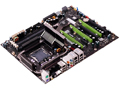
XFX nForce 790i Ultra SLI Motherboard Review

XFX nForce 790i Ultra SLI Motherboard Review

The XFX nForce 790 Ultra SLI motherboard is designed for the latest generation 45nm Core 2 processors with Front Side Bus speeds of up to 1600MHz. Based on the NVIDIA nForce 790i MCP chipset, this powerful ATX platform supports all the latest enthusiast technology. This versatile platform is SLI 3-way and 2-way ready and features NVIDIA Enthusiast System Architecture, MediaShield Storage, NVIDA System Tools, and NVIDIA DualNet Technology. Read on to see how it performs!

ASUS Says Intel’s Atom Chip Faces Supply Squeeze

The newest member of Intel's chip family, the low-cost Atom processor, hasn't begun shipping, yet there may not be enough of them. Computer makers, who want Intel's new microprocessor for a nascent breed of low-cost, extra-small notebooks, are predicting that there won't be enough Atom processors to go around when it becomes available later this year.

We will see a severe shortage in Atom processors that will last well into the third quarter,” said Asustek CEO Jerry Shen during a conference call discussing the Taiwanese firm's first-quarter financial results, according to news reports. Asustek has been at the forefront of the new market for low-cost notebooks with its Eee PC, a stripped-down device that's half the size of traditional notebook PCs and can cost as little as $299.

Intel China Foundry to Start Operation in 2010

US chipmaker Intel Corp. is said to have gained approval from the US government to use the 65nm silicon process technology in its Dalian-based chip foundry. The saying was confirmed by Xia Deren, mayor of Dalian, a coastal city in East China's Shandong Province, where the US chipmaker won a nod to build its first foundry in China last year. The construction of the foundry has been almost completed and it is expected to start operation in early 2010, revealed the mayor.

Intel, the world's largest chipmaker, set up foundries in developed countries only in the past. It was allowed to use 90nm silicon process technology in China when it first gained approval from the US government to build a foundry in the nation. Xia believed that Intel would make an effort to improve its chip production technology in China gradually. Currently, the state-of-the-art silicon process technology is 45nm.

Intel and AMD Join Forces – Pervasive Parallelism Lab

Clock speed is no longer the most important measure on processors prowess. It has been supplanted by performance per watt, which addresses the greening of the chip industry. The performance bump that formerly came from cranking up clock speed is now the province of multicores. The only problem is that most software isn't good at taking advantage of multicore architectures. To overcome that hurdle, Stanford University is partnering with Sun Microsystems, Advanced Micro Devices, Nvidia, IBM, Hewlett-Packard, and Intel to create software that will allow chips to more efficiently process many tasks at the same time, according to a report in The New York Times.

The effort–dubbed the Pervasive Parallelism Lab–is expected to be announced by the group on Friday, according to the report. The project follows similar efforts announced last month by Intel and Microsoft, which are committing a combined $20 million to fund parallel computing research centers at the University of California at Berkeley and the University of Illinois at Urbana-Champaign.

VIA Launches Open Source Driver Development Portal

VIA Technologies today announced the launch of a beta version of the VIA Linux Portal as part of an initiative designed to extend collaboration with the Open Source community. The beta version of the VIA Linux Portal is located at http://linux.via.com.tw and currently offers driver files for Ubuntu 8.04 LTS and SUSE Linux Enterprise Desktop 10 Service Pack 1 for the VIA CN896 chipset with two south bridge options.

The VIA Linux Portal will initially offer graphics drivers for the VIA CN896 digital media IGP chipset for the new Ubuntu 8.04 LTS distribution. Documentation and source code for these drivers will be released over the coming weeks, with official forums and bug tracking scheduled for implementation later this year. The VIA Linux Portal will also adhere to a regular release schedule that is aligned with kernel changes and the release of major Linux distributions.

April 30 News from Around the Web

Virtual Hideout's Vantec NexStar Hard Drive Dock Review and other reviews from around the web can be found in our forums!

The Vantec NexStar Hard Drive Dock lived up to its promise. It provides a convenient method of connecting any SATA drive to your system so that you can easily access the data on it. Performance was up to par, but the real benefit is from the design. During disaster recovery, you need something that's straightforward and easy to use and won't add more trouble to your life. The NexStar Hard Drive Dock succeeds in this aspect.

XP update delayed over glitch

Microsoft on Tuesday said it is delaying the release of Windows XP Service Pack 3 because of a newly uncovered glitch.

The software maker said there is a “compatibility issue” between the XP service pack and Microsoft Dynamics Retail Management System, a retail chain management program for small and midsize businesses.

Microsoft finalized the code for Windows XP SP3 last week and had planned to make it broadly available starting Tuesday.

“In order to make sure customers have the best possible experience, we have decided to delay releasing Windows XP SP3 to Windows Update and Microsoft Download Center,” the company said in a statement.

The glitch also exists between Microsoft Dynamics RMS and Windows Vista Service Pack 1, though that product has already been broadly released. Microsoft started pushing out Vista SP1 last week via Automatic Updates.

Industry leaders join push for home media networks

Chip and electronics makers Intel (INTC.O: Quote, Profile, Research), Infineon (IFXGn.DE: Quote, Profile, Research), Texas Instruments (TXN.N: Quote, Profile, Research) and Panasonic (6752.T: Quote, Profile, Research) have formed an alliance to promote home networks for movies, music and pictures using domestic wiring.

The four leading chip and electronics makers will help market and test a standard to wire together computers, TVs and entertainment systems using electricity, phone and coaxial cable lines that already exist in most homes, they said on Tuesday.

They hope the first products using the new standard will be on the market in about a year.

Consumer electronics and computer makers have long talked of the so-called digital home, in which entertainment appliances and PCs are linked and typically controlled from the computer, making it easy to share digital media content between devices.

But a lack of common standards between makers of these devices has held back progress.

There is already a common wireless standard to link home devices using Wi-Fi. Wired networks often have the advantage of being more stable and having more capacity, and the building blocks for the infrastructure already exist in most homes.

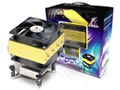
Glacialtech Igloo 5750 Silent CPU Cooler

Glacialtech Igloo 5750 Silent CPU Cooler

Today we take a look at the Igloo 5750 Silent from GlacialTech. With words like igloo and silent in the name you think cool and quiet and that is what we figure out. The PWM version that we are reviewing has a dual adjustable speed fan setup which brings the temperature down according to your needs. The speed ranges from 800~2500RPM, with a maximum volume throughput of 51.3CFM! Read on to see if this budget minded CPU cooler can live up to its name.

Razer Introduces The DeathAdder Gaming Mouse For Mac OS X

Razer has launched the Lunar White Razer DeathAdder, an ergonomic right-handed gaming mouse specifically built with the needs of Mac OS X gamers in mind. This is the first gaming mouse in Razers arsenal specifically developed for the Mac gamer! The Razer DeathAdder will retail for US: $59.99 in North America and 49.99 in Europe. The Razer DeathAdder for PC can be found online for as little as $21 plus shipping, so the Mac version is more than double the PC version.

The Razer DeathAdders renowned Razer 3G Infrared Sensor technology and engineering improvements make it ideal for Mac OS X gamers in need of a fully feature gaming mouse. The DeathAdder for Mac OS X features the 1800 DPI (dot per inch), Razer Precision 3G infrared sensor with 1000Hz Ultrapolling/1ms response and a tracking speed of up to 120 inches per second (IPS). All these features of the Razer DeathAdder for the Mac OS X further empower gamers with unprecedented levels of accuracy, precision and tracking speed for First Person Shooter gamers (that play classical Mac OS X games like Unreal Tournament, Halo and Quake III Arena).